Machine Learning & AI·Software Engineering

Arnesh Banerjee

I'm a senior (B.Tech CSE, minor in Data Science) with real world experience in medical imaging, multi-omics cancer modelling and LLM alignment, plus ML infrastructure and systems work in Rust, C++ and Go.

I am currently interning at Indian Institute of Technology, Kharagpur, with previous experiences at Jadavpur University and New Jersey Institute of Technology, Newark.

For fun, I build things like Kimi K3 for All, the end to end training pipeline for the Kimi K3 model and contribute to open source projects like OpenCV, Zed Editor, Kubescape.

Reach me at

Experience

Where I've worked.
Technical details
  • Built six independently trained per-modality models (bulk RNA-seq, DNA methylation, miRNA, copy-number, somatic-mutation, and a leakage-safe clinical model) by porting the Cedars-Sinai / Betteromics Molecular-Twin methodology to the TCGA head-and-neck cohort, evaluated over 1,206 samples from 1,160 patients (58,147 genes) under patient-grouped, label-stratified 5-fold cross-validation with zero leaked patients.
  • Reframed the task from binary oral-vs-rest detection to ten-class tumour typing, reaching 0.84 accuracy and 0.90 balanced accuracy while confining almost all error to the clinically hard oral vs non-oral head-and-neck block that the binary framing had masked.
  • Engineered a deployed decision-support system in which a self-hosted Qwen3-32B orchestrator aggregates the six model predictions weighted by cross-validated reliability, backed by a knowledge-graph RAG fallback on low confidence and a deterministic safety layer that only escalates risk.
  • Diagnosed a training-set leakage confound (weak modalities scoring a perfect 1.000 against honest ROC-AUCs of 0.60 to 0.82) that capped both the LLM and ML baselines at a ~0.98 ceiling, and specified the held-out-cohort correction required for a valid comparison.

Technical details
  • Designed a hybrid CNN-Transformer segmentation model (ResNet-34 encoder, ASPP, Transformer bottleneck, and SE-gated skip connections with a differentiable Chan-Vese level-set loss), reaching 0.9716 Dice and 0.9463 IoU on the DMR-IR dataset (357 thermograms, 119 patients) under patient-stratified 5-fold cross-validation.
  • Surfaced an annotation-quality ceiling in weakly supervised thermography by benchmarking against four state-of-the-art baselines (Attention U-Net, UNet++, DeepLabV3+, TransUNet) across five metrics (Dice, IoU, HD95, ASSD, BF1) and showing all models converge to a statistically indistinguishable Dice of ~0.97 (p > 0.05, paired Wilcoxon with 1,000-resample bootstrap CIs).
  • Built a robustness battery (label-noise injection at 10% to 30%, augmentation regimes, 25% to 100% training subsets) and an explainability suite (Grad-CAM, attention maps, Monte-Carlo dropout uncertainty) to make the model clinician-facing.
Technical details
  • Constructed a curated safety dataset of 2,500 prompt-response pairs spanning benign, context-sensitive, and jailbreak categories, and fine-tuned the final six layers of LLaMA-2-7B-chat-hf into a semantic cost model reaching 92% alignment with human safety judgments.
  • Benchmarked the cost model on the external XS-Test suite, scoring 0.91 to 0.96 against 0.07 to 0.32 for the Safe-RLHF baseline, demonstrating semantic grounding over keyword-triggered over-refusal.
  • Demonstrated across 1,000-prompt and 1,172-pair human-preference evaluations that the trained policy flags unsafe responses more efficiently than Safe-RLHF and wins 60% of head-to-head comparisons (+70 Elo) against the strongest baseline, SACPO; co-authored the resulting preprint (arXiv:2510.03520).
Technical details
  • Raised breast-cancer classification accuracy to 97.77% on WDBC (Logistic Regression, 13 features) and 93.67% on WPBC (SVM, 18 features) by applying RFE/SFS wrapper feature selection, SMOTE class balancing, and GridSearchCV tuning across five classifiers (RF, SVM, Logistic Regression, MLP, XGBoost) under stratified 10-fold cross-validation.
  • Identified the nuclear morphology features (texture, concavity, symmetry, fractal dimension) most predictive of malignancy and recurrence through a comparative analysis across model and feature-selection combinations in a dual-stage diagnosis-and-recurrence framework.

Projects

Things I've built.

Kimi K3 for All

Moonshot released inference code for Kimi K3 but never the training pipeline behind it. This project builds that pipeline from scratch and trains a small model with it, documented in the blog post above.

Python PyTorch Transformers Triton CUDA

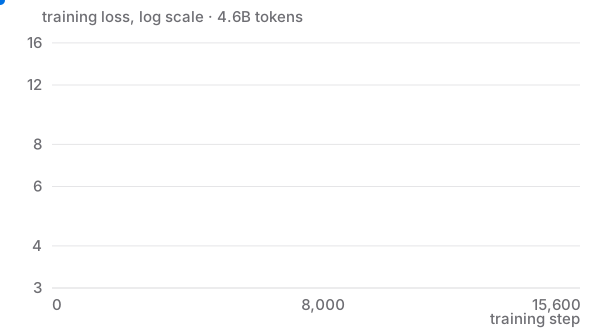
Training loss falling from 15.86 to 3.27 over 15,600 steps

DebateBench

A multi-LLM debate platform. Anonymised agents argue a topic over several rounds, and each round's winning response becomes shared context for the next.

Every agent gets a fresh random code each round, so the orchestrator judging them never learns which model wrote what and can't build a bias toward one.

Python LiteLLM Docker uv Ollama

Smart Competency Diagnostic

A Flask app that reads a candidate's resume PDF, pulls out skills, education and experience, and scores the profile against the roles it matches.

TF-IDF and random-forest models handle the categorising and job matching, with cosine-similarity recommenders suggesting courses to close the gaps. The job data came from Indeed and SimplyHired listings scraped for the project.

Python Flask scikit-learn PyPDF2 Web scraping

Open Source

Contributions I've made to open source projects.

GitHub

A year of commits.

Publications

Peer reviewed.

Recursive and Wrapper-Based Feature Selection for Breast Cancer Diagnosis and Prognosisoral Ayushi Bhattacharjee, Arnesh Banerjee, Arpita Talukdar. 4th Analytics Global Conference (AGC 2026), March 2026. · certificate

Preprints

Not yet peer reviewed.

Certifiable Safe RLHF: Semantic Grounding and Fixed Penalty Constraint Optimization for Safer LLM Alignment Kartik Pandit, Sourav Ganguly, Arnesh Banerjee, Shaahin Angizi, Arnob Ghosh. 2025. arXiv:2510.03520
Failure Modes of Large Language Models on Research-Level Mathematics: A Taxonomy and an Empirical Characterisation Arnesh Banerjee, Ayushi Bhattacharjee. arXiv:2606.24902
An Intelligent Weakly Supervised Framework for Breast Thermography Segmentation Using Hybrid CNN–Transformer Networksin prep Arnesh Banerjee, Debotosh Bhattacharjee. In preparation for Expert Systems with Applications.

Guestbook

Say hi.

Passing through? Sign in with GitHub, Google, or Discord and leave a note below.

Loading guestbook…